Comparison of Aid for Small Businesses

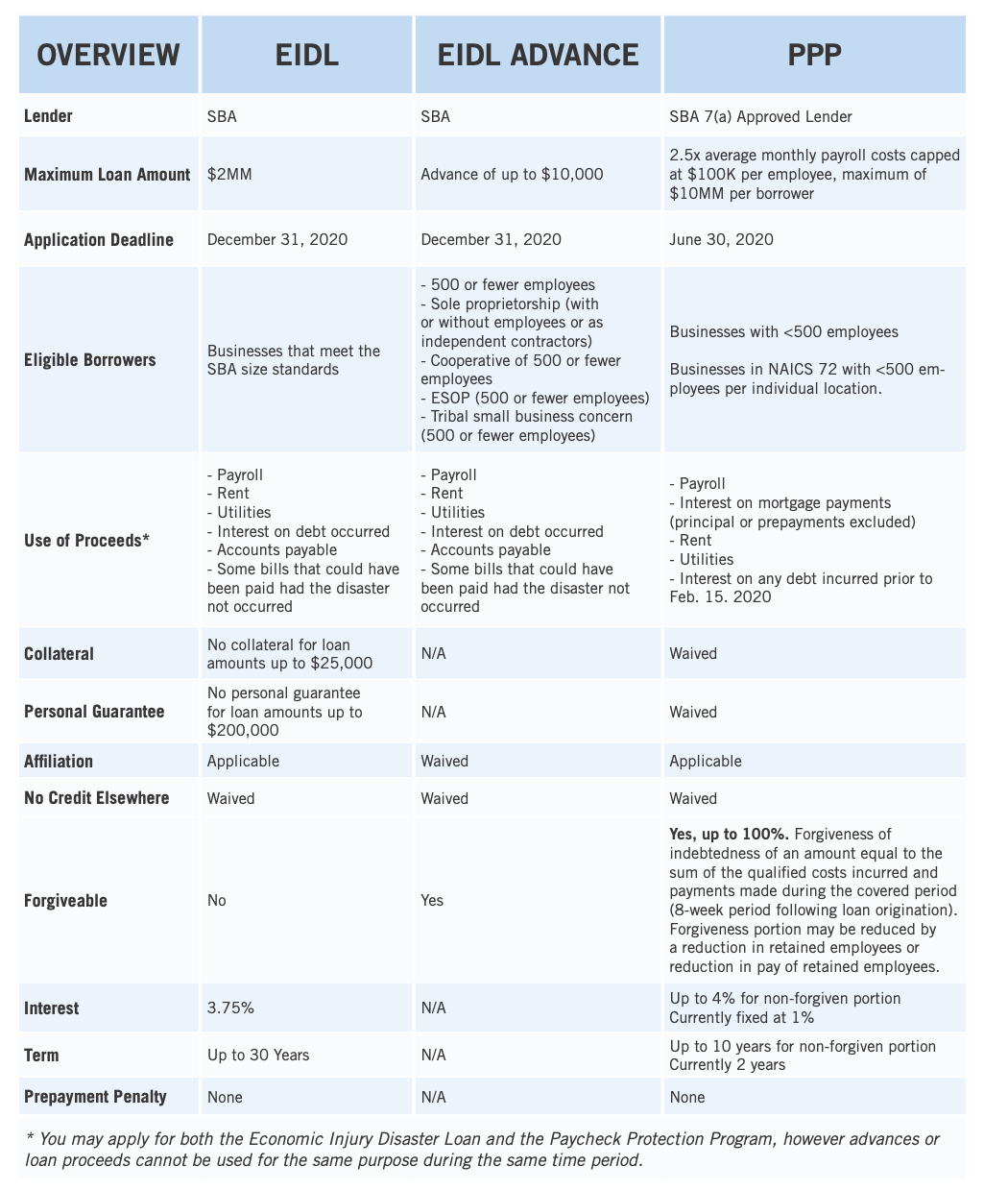
The chart below is courtesy of The University of Georgia Small Business Development Center (SBDC), which provides a way to quickly compare the aid available to small businesses.

This chart was accessed on April 8, 2020, and the information within is subject to change. While it is a helpful reference, we recommend visiting the US Treasury and Small Business Administration for the latest information.

Tips for S Corporation Reasonable Compensation

We talk a lot about Reasonable Compensation for S Corporation shareholder-employees here at Woodruff Accounting, and it is a vitally important concept for small businesses. The IRS requires for reasonable compensation to be paid to shareholder-employees before any non-dividend distribution can be taken, though S corporations are not required to pay the reasonable compensation if they would rather defer it until later.

Authors Paul S. Hamann & Jack Salewski, CPA, CGMA write on “RCReports.com” about this concept of when and how to take reasonable compensation, especially in instances where your company may not be able to afford to pay the compensation. Keep reading for an excerpt from their article titled, “What if an S Corp Owner can’t afford to pay Reasonable Compensation?”, or visit RC Reports for the full article, which includes several examples to help illustrate this concept.


Depending on the company’s financial condition and business strategy, a shareholder-employee may be able to take Reasonable Compensation plus a distribution, just Reasonable Compensation, or neither. What the shareholder-employee can’t do take a distribution instead of Reasonable Compensation.

To help you better understand, let’s run through a few simple scenarios and then move onto some more advanced ones. Keep in mind the following:

  1. Reasonable Compensation is defined by the IRS as: “The value that would ordinarily be paid for like services by like enterprises under like circumstances.” or the hypothetical “Replacement Cost” of the shareholder-employee.
  2. Reasonable Compensation is based on the value of services provided (Hypothetical Replacement Cost), not profit, distributions or the amount the company can afford to pay.
  3. Wages (Reasonable Compensation) should be paid BEFORE distributions are made.
  4. A shareholder-employee can take wages (Reasonable Compensation) without taking a distribution, but not vice versa.
  5. A shareholder-employee who does not want to take any Reasonable Compensation can refuse all compensation (distribution), and play ‘catch up’ in a later year.

Reasonable Compensation is derived from the value of the services provided, not the profit or loss of the business.  While Reasonable Compensation has nothing to do with profit and loss, it does relate to Distributions.  Why? Because the IRS guidelines for Reasonable Compensation state: The amount of reasonable compensation will never exceed the amounts received by the shareholder either directly or indirectly.  It does not mention profit or loss at all but instead talks about ‘amounts received’ by the shareholder.  It does not matter if the company is making or losing money; what matters is whether or not the S Corp owner is taking money (e.g. a distribution or other items of value) out of the S Corp.

Anything that compensates the S Corp owner can be re-characterized as wages, including personal expenses paid by the S Corp or loans to the S Corp owner.  At the end of the day a distribution of any kind triggers the requirement to pay Reasonable Compensation for services provided.  Best practice is to know what the value of those services are and pay that amount in Reasonable Compensation before taking a post-wages distribution of any kind.

Tips for Taxes: E-File Authorization and Signatures

Image from JMP Solicitors

As pen and paper become mouse-clicks and keyboard strokes, understanding the importance of E-File authorizations and electronic signatures is critical for ensuring proper electronic tax return filing. Signatures, though not simply signing on the dotted line with a pen, are of equal significance when completed electronically.

We understand that electronic signatures are confusing, and it is easy to sign using unauthorized means, sign in the wrong place, or forget to sign somewhere. To make this process easy, Woodruff Accounting utilizes Citrix RightSignature, a secure program that clearly shows where clients need to sign a document or return and provides the proper signature security and authorization. RightSignature also allows you to sign a document on any device, and it clearly walks you through the places to sign a document. Simple, safe, secure.

Let us know if you have any questions about RightSignature or electronic filing!

Tips for Taxes: Utilizing ShareFile

Over the next few weeks, we will be posting some “Tips for Taxes” here on the Woodruff Accounting blog to help clients and prospective clients become more aware of some of the tools and tips we suggest to make Tax Season as easy for our clients as possible.

Today’s tip is about Citrix ShareFile: an online file-sharing system that we use to securely share documents between our firm and our clients. We love ShareFile because it is secure, straightforward, and provides for maximum visibility of your documents before, during, and after filing your taxes. Each client receives their own personal ShareFile login that allows them to easily share files with top-notch security and encryption.

We have a link to our ShareFile on the right sidebar of our website, so that it is easy to access from any page. Be sure to bookmark woodruffaccounting.com for easy access to ShareFile!

Bonus Depreciation Changes Could Benefit Your Business Taxes

Image via “Americans for Tax Reform.”

One of the many recent governmental changes that affects business taxes is a change in bonus depreciation passed by Congress in December 2017. The new changes increase the bonus depreciation percentage from 50% to 100% for qualified assets purchased and put into service after September 27, 2017, and before January 1, 2023.

The bonus depreciation decreases in 2023 to 80%, 60% in 2024, 40% in 2025, 20% in 2026, and will not be available in 2027.

Contact us for more information or to discuss if you have assets that qualify for bonus depreciation.

S Corporation Salary Insights

If you are the owner of an S Corporation, how do you calculate what to pay yourself and other shareholders? The Watson CPA Group put together an article on this topic with wonderful illustrations to help you calculate shareholder salaries. Keep reading for an excerpt, or click here for the full article.

“Determining a reasonable shareholder salary is the hardest part of running an S corporation. What the heck do I pay myself? Before we get into that, let’s discuss why a reasonable S Corp wage needs to be just above bar napkin quality and just below NASA precision. The Watson CPA Group has been computing officer compensation since 2007, and we believe we have it dialed in as well as anyone can.

Scattered throughout our website and book we’ve stressed that the only tax savings an S Corp provides is the reduction of self-employment taxes, and in the case of S corporation compensation we are talking about Social Security and Medicare taxes (payroll taxes). When your company, or any company, pays you $10,000 in shareholder wages, 7.65% is withheld from your pay check for the employee’s portion of payroll taxes. This is broken down into 6.2% Social Security and 1.45% Medicare. Your company must also pay 7.65% for a combined percentage of 15.3%. Adding on 25% in income taxes equates to a 40% tax rate… yuck!

Therefore, a $10,000 shareholder salary costs you $1,530 in additional taxes beyond income taxes. Said in a different way, if you pay yourself $50,000 when $40,000 could have been a reasonable shareholder salary, you just wasted $1,530. Even a $5,000 delta equates to $765. As such, your S Corp officer compensation needs to be reasonable, sure, but it also needs to be as low as reasonableness and not-so-common sense will allow.

IRS S Corp Stats

Let’s jump right into some numbers first before going through reasonable S Corp salary theory developed from IRS revenue rules and tax court cases. The following table is a summary generated from IRS statistics on S corporation tax returns for the 2013 tax year. Yes, this is the most current. No, we do not know why a room full of servers can’t crunch this in real-time. So here we are-

Gross Receipts Net Income Officer Comp Officer Comp %
Annual Receipts Per Return Per Return Per Return of Net Income
$25,000 to $99,999 62,552 6,672 8,871 57%
$100,000 to $249,999 168,051 22,194 22,786 51%
$250,000 to $499,999 365,476 37,732 43,158 53%
$500,000 to $999,999 720,013 58,351 67,474 54%
$1M to $2.5M 1,572,621 119,808 110,911 48%

First some quick observations. Officer compensation is added back to net income to determine officer comp as a percentage of net income. Next, this is all industries from capital intensive manufacturing to personal services business such as attorneys, doctors, consultants, engineers and accountants. Also, this includes S Corps who lost money, and whether they lost money and continued to pay a reasonable shareholder salary (officer compensation) is unclear. In other words, if losses were teased out would officer compensation be reduced as a percentage of net income? We cannot quickly determine.

Here is the same data grouped by gross receipts but detailed by selected industries. First one is $100,000 to $249,999 in gross receipts-

Gross Receipts Net Income Officer Comp Officer Comp %
$100,000 to $249,999 Per Return Per Return Per Return of Net Income
Finance and Insurance 160,359 34,408 23,213 40%
Real Estate 165,375 38,231 28,193 42%
Professional, Scientific 163,151 32,910 35,404 52%
Health Care 174,383 24,622 36,026 59%

And now for $250,000 to $499,999 in gross receipts-

Gross Receipts Net Income Officer Comp Officer Comp %
$250,000 to $499,999 Per Return Per Return Per Return of Net Income
Finance and Insurance 366,533 77,518 62,329 45%
Real Estate 359,163 65,419 51,151 44%
Professional, Scientific 355,693 71,136 74,493 51%
Health Care 378,147 51,553 75,382 59%

There you go. Remember that officer compensation includes all fringe benefits such as self-employed health insurance and HSA contributions, and it might be influenced (increased) by those who want to maximize 401k deferrals and / or defined benefits pensions.”

Cyber Security Awareness Month

As your CPA, we are trusted to help you navigate challenges and mitigate risks. The top risk individuals and business face today is Cybersecurity. With cyber attacks, malware, phishing emails, and more on the rise, it is more important than ever to be alert and informed on how to stay protected from cyber theft and crimes.

October is National Cybersecurity Awareness Month, which is a great time to reflect on ways to protect yourself and/or your company from cyber crime. Below are links provided by the American Institution of Certified Public Accountants (AICPA) that give you a glimpse of information we are focusing on regarding your business security challenges.

  • The AICPA Cybersecurity Resource Center is your hub for all things cybersecurity. Whether you’re looking to keep your business safe, or you are an experienced technology professional interested in offering cybersecurity services, the tools you need are here.
  • Need information about protecting your organization? Check out the CGMA Cybersecurity Tool for risk, response and remediation strategies.
  •  The AICPA Insights blog contains articles and information that we reference for protecting our clients’ tax data.
  • The AICPA is releasing new resources from leading experts all month long on their Facebook page, Go Beyond Disruption podcast, and Insights blog.

SC Tax Relief for Hurricane Florence

Image: NASA

In the wake of Hurricane Florence, the IRS has announced tax relief for South Carolina residents and businesses affected by Hurricane Florence. As of October 3, 2018, eligible South Carolina counties include Chesterfield, Darlington, Dillon, Florence, Georgetown, Horry, Marion, and Marlboro.

According to the IRS announcement, “certain deadlines falling on or after Sept. 8, 2018 and before Jan. 31, 2019, are granted additional time to file through Jan. 31, 2019. This includes taxpayers who had a valid extension to file their 2017 return due to run out on Oct. 15, 2018. It also includes the quarterly estimated income tax payments due on Sept. 17, 2018 and Jan. 15, 2019, and the quarterly payroll and excise tax returns normally due on Oct. 31, 2018. It also includes tax-exempt organizations that operate on a calendar-year basis and had an automatic extension due to run out on Nov. 15, 2018.

“The IRS automatically identifies taxpayers located in the covered disaster area and applies automatic filing and payment relief. But affected taxpayers who reside or have a business located outside the covered disaster area must call the IRS disaster hotline at 866-562-5227 to request this tax relief.”

An article by Drake Software explains, “If a qualified taxpayer gets a late filing or late payment notice from the IRS with a due date within the postponement period, the taxpayer should call the telephone number given on the written notice to have the IRS abate the penalty.”

Read more from the IRS and Drake Software for additional information.

Four Things You Should Know about the Child Tax Credit

The Child Tax Credit is an important tax credit that may save you up to $1,000 for each eligible qualifying child. Be sure you qualify before you claim it. Here are four useful facts from the IRS on the Child Tax Credit:

1. Qualifications. For the Child Tax Credit, a qualifying child must pass several tests:

  • Age. The child must have been under age 17 at the end of 2015.
  • Relationship. The child must be your son, daughter, stepchild, foster child, brother, sister, stepbrother, stepsister, half brother, or half sister. The child may be a descendant of any of these individuals. A qualifying child could also include your grandchild, niece or nephew. You would always treat an adopted child as your own child. An adopted child includes a child lawfully placed with you for legal adoption.
  • Support. The child must have not provided more than half of their own support for the year.
  • Dependent. The child must be a dependent that you claim on your federal tax return.
  • Joint return. The child cannot file a joint return for the year, unless the only reason they are filing is to claim a refund.
  • Citizenship. The child must be a U.S. citizen, a U.S. national or a U.S. resident alien.
  • Residence. In most cases, the child must have lived with you for more than half of 2015.

2. Limitations. The Child Tax Credit is subject to income limitations. The limits may reduce or eliminate your credit depending on your filing status and income.

3. Additional Child Tax Credit. If you qualify and get less than the full Child Tax Credit, you could receive a refund even if you owe no tax with the Additional Child Tax Credit.

4. Schedule 8812. If you qualify to claim the Child Tax Credit, make sure to check if you must complete and attach Schedule 8812, Child Tax Credit, with your tax return. For example, if you claim a credit for a child with an Individual Taxpayer Identification Number, you must complete Part I of Schedule 8812. If you qualify to claim the Additional Child Tax Credit, you must complete and attach Schedule 8812. You can visit IRS.gov to view, download or print IRS tax forms anytime.


SC Refunds are Coming In!!

ALERT!!! SC refunds are starting to come in!  The SC refunds are coming in the mail instead of being Direct Deposited into your bank account… Please be on the lookout for your refunds!! We were not given an explanation as to why this is happening only that it is!!

Thanks,                                                                                                                                                                Woodruff Accounting